Before meeting Lance in Bali around March, I've always thought of Buddhism as a very “dry” belief centered around suffering. You meditate, notice the suffering in the world and then meditate some more... (Meditation by itself is a horrible form of suffering for me, my knees hurt and my mind constantly searches for an escape plan from the cross-legged seating.) On the other hand, Hinduism is spicy; countless gods, stories, rituals and everything else. Buddhism doesn't have a god, heaven, hell, warriors that can jump across the ocean, that's why I thought it was dry. Talking to Lance and having a first hand experience of his Buddhist spiritual guides surprised me a lot and made me wonder what else is there...
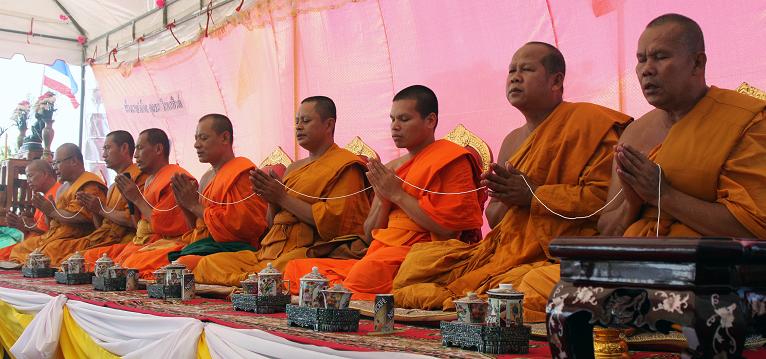
Coming to Thailand with this different view point, talking to devoted Buddhists, visiting 2 major temples and living in one of them for about 3 weeks plus being blessed by one of the most powerful monks have completely changed my ideas about Buddhism. It is highly spirited, it has a very clear and strong energy. What we call “supernatural” is often considered as very natural in Thailand. Senior monks often have powers to bless, offer protection, sometimes even see the future or read minds. During ceremonies, people receive blessings or protective amulets from monks and use them everywhere. I've already received enough protective bracelets, pendants, holy ropes to use with the pendants that would probably last me for the rest of my life. This all makes sense to me, I've experienced the difference that the energy of these pendants and photos create so I do believe in them without a doubt.
Today 5 monks and one of the residents of the monastery took me to a sight-seeing tour. The first stop was to another monastery nearby. It was small and rather shabby, just a few hundred meters away from the border of Burma. I was told that the abbot had a stone that would answer questions about your future. Hmm... We paid our respects, monks talked among themselves for a while and I sat there with a shy smile plastered across my face, knowing that I was the center of attention. A foreign woman arriving to a small monastery in the Burma border with 5 monks in a pick-up truck does attract some curiosity and I can understand that.
Then the abbot brought the stone from a locked room. I was told that he would never take it out for public; it was only for monks and for special occasions, which made me feel a little privileged. The abbot prayed and gave us a quick demo. I would hold the stone in my hands, meditate on my question and choose a direction for the stone to move, then put the stone on the floor and my hands on it. If the answer is yes, the stone would turn in the direction I chose. If it's no, there would be no movement. 2 monks tried it. It didn't work for one of them, and there was a slight twist for the other.
It was my turn and I was a little scared; The question I had in my mind was a centrally important one for me and a negative answer would make me feel quite devastated. Yet I was curious. I took the stone and asked my question. I was told that I would need to meditate for a few minutes before the stone moves, but for me it started moving almost immediately towards left, which was the direction I chose along with my question. I was ecstatic for a positive answer but at the same time stunned by the movement I was feeling under my hands. The stone kept turning and the abbot told me to keep moving with it. Somewhere near 270 degrees, he told me to mentally aim for a right-turn as a confirmation to my question. I closed my eyes and did exactly as told and then the stone started to turn towards right! I followed it's movement for about another 180 degrees and then everyone was convinced
that my wish would come true. As I passed the stone to the next person who wanted to try, my hands were trembling in a high frequency. I was feeling the energy of the stone all the way up to my elbows. I sat in amazement and with gratitude for a while.
The stone started moving almost immediately for the next person too. But this time its movement was much faster and sharp. Later the abbot explained that the harder you press on the stone or the more weight you put on it the bigger the movement would be. In the past there were people who didn't believe in the power of the stone and instead of putting on their hands, they laid on the stone. The stone moved their whole bodies in fast circles!
Having a first-hand experience is very different that hearing the story of something that happened to someone else. I believe in the powers of the senior monks and their protective abilities. I believe that one can purify his/her mind through meditation to a level to see the future. I believe that chanting can change the energy of a place. I believe in all of that because I have experienced them.
Today was just another day in Thailand, just a little closer to Burma... And with a little more faith in my own future.
Coming to Thailand with this different view point, talking to devoted Buddhists, visiting 2 major temples and living in one of them for about 3 weeks plus being blessed by one of the most powerful monks have completely changed my ideas about Buddhism. It is highly spirited, it has a very clear and strong energy. What we call “supernatural” is often considered as very natural in Thailand. Senior monks often have powers to bless, offer protection, sometimes even see the future or read minds. During ceremonies, people receive blessings or protective amulets from monks and use them everywhere. I've already received enough protective bracelets, pendants, holy ropes to use with the pendants that would probably last me for the rest of my life. This all makes sense to me, I've experienced the difference that the energy of these pendants and photos create so I do believe in them without a doubt.
 |
| meditating on the rock |
Then the abbot brought the stone from a locked room. I was told that he would never take it out for public; it was only for monks and for special occasions, which made me feel a little privileged. The abbot prayed and gave us a quick demo. I would hold the stone in my hands, meditate on my question and choose a direction for the stone to move, then put the stone on the floor and my hands on it. If the answer is yes, the stone would turn in the direction I chose. If it's no, there would be no movement. 2 monks tried it. It didn't work for one of them, and there was a slight twist for the other.
 |
| and the rock starts to turn notice the surprise in the faces of the monks? |
It was my turn and I was a little scared; The question I had in my mind was a centrally important one for me and a negative answer would make me feel quite devastated. Yet I was curious. I took the stone and asked my question. I was told that I would need to meditate for a few minutes before the stone moves, but for me it started moving almost immediately towards left, which was the direction I chose along with my question. I was ecstatic for a positive answer but at the same time stunned by the movement I was feeling under my hands. The stone kept turning and the abbot told me to keep moving with it. Somewhere near 270 degrees, he told me to mentally aim for a right-turn as a confirmation to my question. I closed my eyes and did exactly as told and then the stone started to turn towards right! I followed it's movement for about another 180 degrees and then everyone was convinced
that my wish would come true. As I passed the stone to the next person who wanted to try, my hands were trembling in a high frequency. I was feeling the energy of the stone all the way up to my elbows. I sat in amazement and with gratitude for a while.
The stone started moving almost immediately for the next person too. But this time its movement was much faster and sharp. Later the abbot explained that the harder you press on the stone or the more weight you put on it the bigger the movement would be. In the past there were people who didn't believe in the power of the stone and instead of putting on their hands, they laid on the stone. The stone moved their whole bodies in fast circles!
Having a first-hand experience is very different that hearing the story of something that happened to someone else. I believe in the powers of the senior monks and their protective abilities. I believe that one can purify his/her mind through meditation to a level to see the future. I believe that chanting can change the energy of a place. I believe in all of that because I have experienced them.
Today was just another day in Thailand, just a little closer to Burma... And with a little more faith in my own future.